Levi would feel it first through the thin glass of his dormitory window in Ahmadi, rattling softly as if reminding him that another shift waited. By five in the morning, he was already awake, lacing up steel-toed boots and tying a faded scarf around his neck to keep the sand off his face. Outside, the sky over Kuwait was a pale lavender, slowly warming into gold.
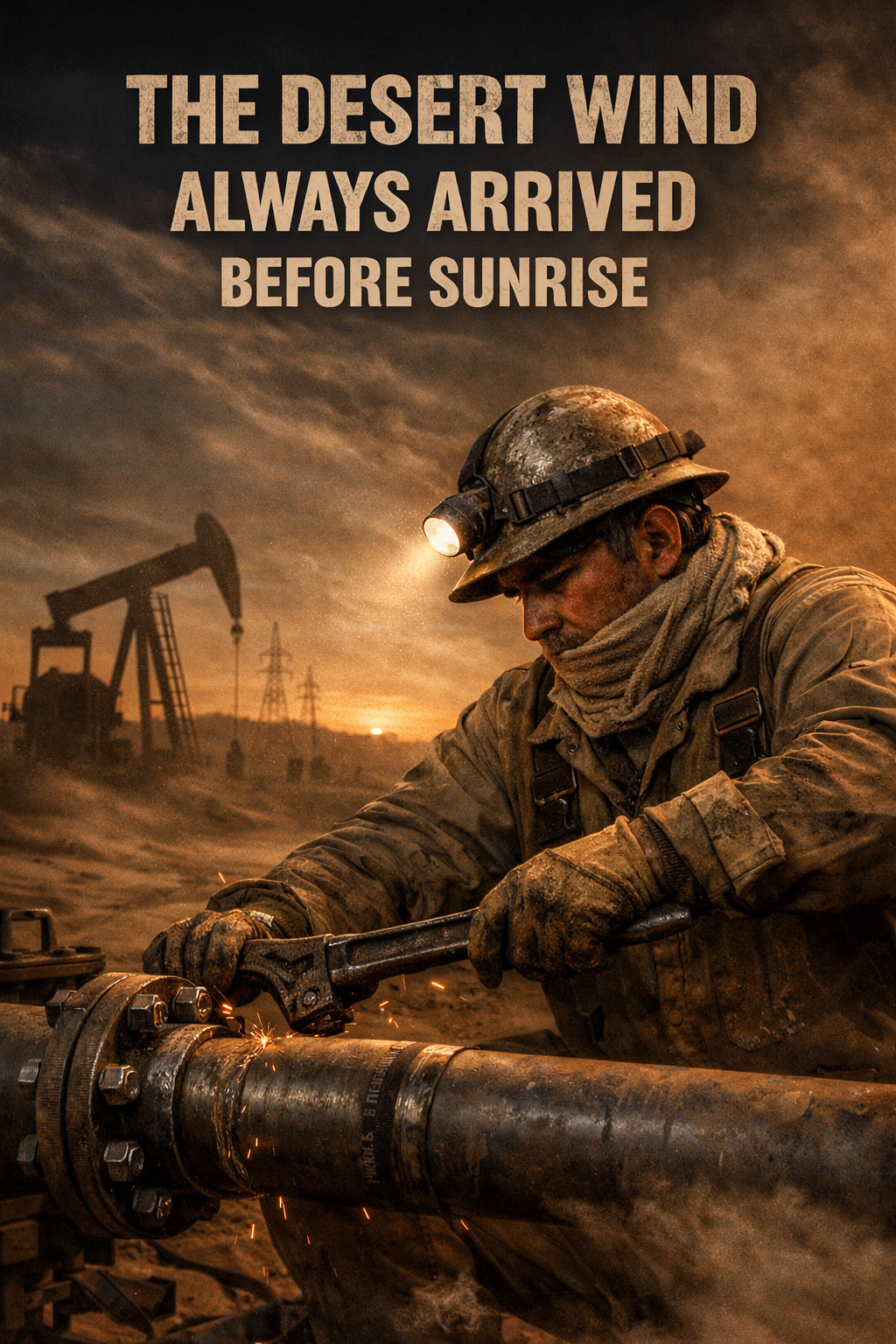
He was a pipe fitter at one of the massive oil facilities near the edge of the desert. To most people, pipes were just steel tubes carrying something unseen. But to Levi, they were lifelines arteries running through the industrial body of the country.
Every morning, the company bus rolled past rows of beige buildings and into the wide industrial zone. Towers of steel rose like mechanical palm trees against the horizon. The smell of oil mixed with hot metal and dust. It wasn’t beautiful in the traditional sense, but to Levi, it was honest.
He hadn’t planned on becoming a pipe fitter. Back in his hometown, far from the Gulf, he had studied mechanical drafting for a year before money ran out. When a recruitment agency offered work in Kuwait, he said yes without hesitation. He told himself it would be temporary just enough to send money home, help his parents fix the leaking roof, and pay for his younger sister’s university tuition.
That was five years ago.
Now he could read a piping isometric drawing like a novel. He understood angles, pressure ratings, flange alignments, and the delicate patience required to line up heavy carbon steel pipes so precisely that not even a drop would leak. He had scars on his knuckles and a permanent tan etched by desert sun.
On this particular morning, the supervisor handed him a new assignment: retrofit a section of aging pipeline in Unit 4. The old pipes had suffered corrosion from years of service. They needed replacement before the summer heat intensified and pushed the system to its limits.
“High pressure,” the supervisor warned. “No mistakes.”
Levi nodded. There were always high stakes in his line of work. One misalignment, one loose bolt, and the consequences could ripple through the entire plant.
He and his team Rafiq from Bangladesh, Murugan from India, and Saleh, a Kuwaiti welder walked toward the site. The sun had climbed higher now, already radiating heat that shimmered above the steel surfaces.
They began by isolating the section of pipeline, ensuring it was depressurized and safe. Levi crouched beside the old pipe, running his fingers along the rough patches where rust had eaten into the metal. He thought about how even steel could weaken overtime. It reminded him of people working far from home strong on the outside, but carrying quiet erosion inside.
By mid-morning, sparks flew as Saleh cur away the corroded section. Levi measured twice, checking the new pipe spool against the blueprint. The alignment had to be exact. The flanges needed to meet as if they were made for each other.
“Little to the left,” Levi called out, guiding the crane operator with careful hand signals. The heavy pipe hovered in the air, swaying slightly. Sweat trickled down his spine beneath his coveralls.
The desert wind returned around noon, stronger this time. It lifted fine sand into the air, stinging exposed skin. Work didn’t stop for wind. Or heat. Or fatigue.
They secured the pipe in place, bolting it temporarily. Levi used a spirit level and calipers, double-checking the angle. A difference of a few millimeters could mean uneven stress once pressure returned.
As he worked, his mind wandered to his family. His mother had called the night before, telling him that the roof no longer leaked during rain. His sister had passed her exams. Every paycheck he sent carried more than money it carried hope.
“Ready for welding,” he said finally.
Levi stepped forward, visor down. The bright arc of welding light cut through the dusty air. Levi watched closely, listening to the steady crackle. Welding wasn’t just joining metal; it was sealing trust into the seam.
By late afternoon, the new section was installed. The team tightened bolts in a star pattern to distribute tension evenly. Levi wiped his hands on a rag, inspecting every joint once more.
When the system was gradually repressurized, everyone stood at a safe distance. The pipes hummed faintly as pressure built inside. Levi held his breath.
No leaks.
The supervisor gave a small nod of approval. In this job, praise was often silent.
As the sun began to sink, painting the desert in deep orange and red, Levi climbed a small steel platform overlooking the maze of pipelines. From above, the facility looked like an intricate web countless lines crossing, bending, connecting. Each one installed by workers like him.
He thought about how invisible their work was. People drove cars, turned on air conditioners, cooked dinner rarely considering the network of pipes and hands that made it possible. But Levi knew. He felt part of something larger than himself.
That evening, back at the dormitory, he video-called his family. The connection flickered, but their smiles were clear. His father asked about the heat. His mother told him to drink more water. His sister teased him about the sand in his hair.
He didn’t tell them about the pressure warnings or the risks. He told them about the sunset instead. About how the sky looked like fire over the refinery.
After the call ended, Levi stepped outside. The night air in Kuwait was cooler, almost gentle. In the distance, refinery flames flickered like steady torches against the dark.
He realized something then. He had come to Kuwait thinking he was just earning money. But over time, the desert had shaped him. It had taught him precision, endurance, and quiet pride. Every perfectly aligned pipe, every secure weld, was proof that he could build something strong in a harsh environment.
Five years ago, he felt like a temporary piece fitted into a foreign land. Now, he understood that he was part of its structure like a flange bolted into place, holding systems together.
The desert wind brushed past him again, softer now.
Tomorrow would bring another shift, another blueprint, another stretch of steel waiting to be aligned. The heat would rise. The sand would sting. The work would demand focus and strength.
And Levi would be there measuring, adjusting, tightening ensuring that the unseen lifelines of Kuwait kept flowing smoothly through the heart of the desert.
Because in the end, being a pipe fitter wasn’t just about steel and pressure ratings.
It was about connection.
Between pipes and flanges.
Between countries and families.
Between sacrifice and hope.
And in the quiet hum of a perfectly sealed line, Levi found something steady and unbreakable inside himself.