Rogelio had always believed that hands told a story.
Back in his hometown in Bicol, his hands were roughfrom farming cracked by sun and soil, shaped by years of planting rice and harvesting coconut. Those same hands used to hold his children when they were small, lifting them high as they laughed under the golden afternoon sky.
Now, those hands wore gloves.
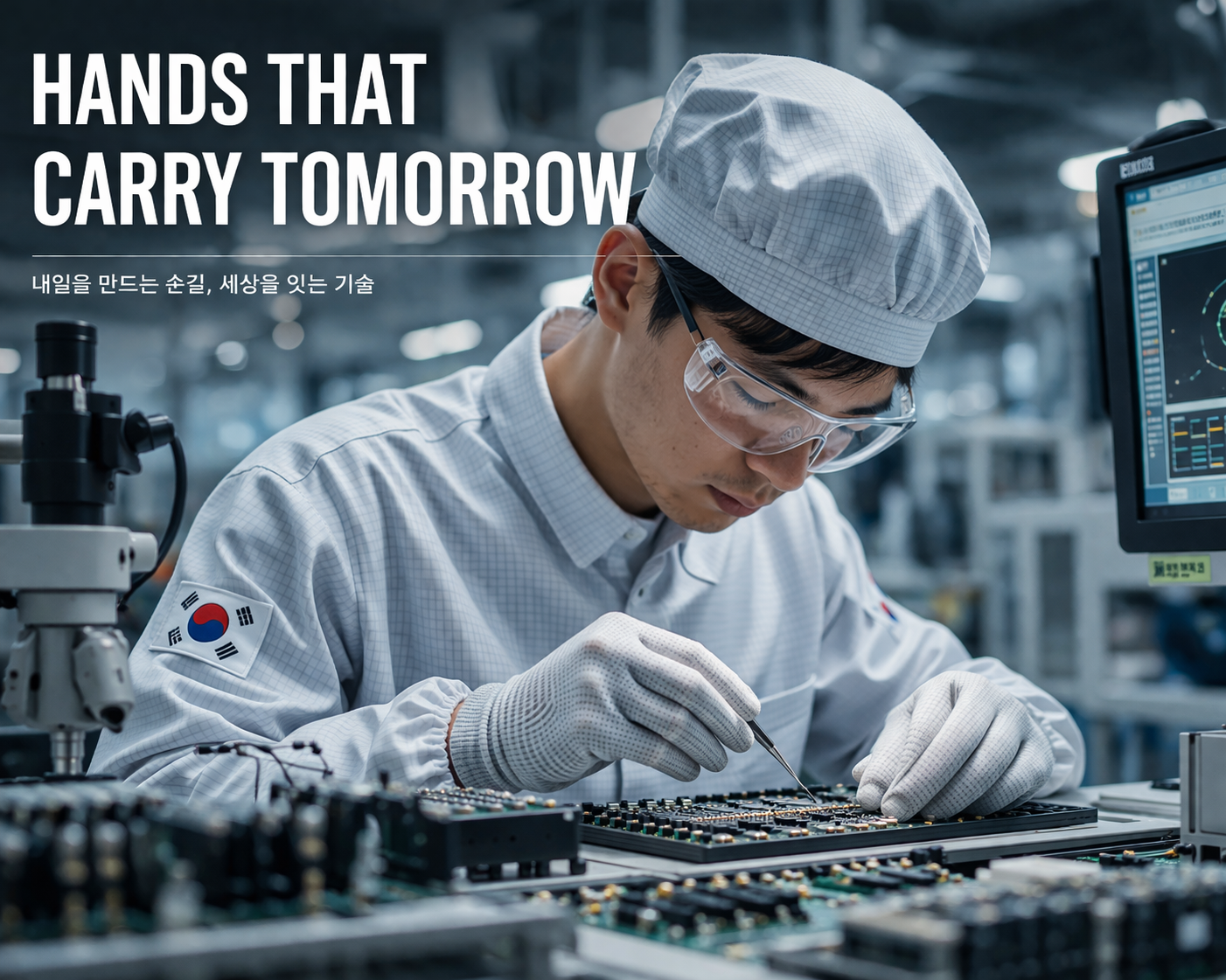
Thick, rubber gloves that protected his skin from chemicals and grime inside a massive factory thousands of miles away.
Rogelio was a factory worker in South Korea.
And every day, his hand carried more than just parts and tools.
They carried the future of his family.
His shift started at 6 a.m.
The factory floor was loud machines roaring, conveyor belts moving endlessly, workers communicating through gestures and quick words. Everything had to be precise. Fast. Efficient.
Mistakes weren’t just costly.
They were dangerous.
Rogelio stood at his station, assembling small electronic components with careful attention. The work was repetitive, but it demanded focus. One wrong move, and the entire batch could be rejected.
He didn’t mind the routine.
In fact, he welcomed it.
Becuase routine meant stability.
And stability meant money sent home on time.
During breaks, Rogelio often sat alone, quietly eating his packed meals usually rice, dried fish, or whatever he could afford. Around him, workers chatted in Korean, laughter rising above the hum of machines.
He understood bits and pieces of their conversations.
But not enough to join.
Loneliness became part of his routine too.
Still, he kept a small photo tucked in his wallet.
His wife, Elena.
And their two children Mika and Joshua.
Whenever he felt the weight of distance, he would take out that photo and remind himself why he was here.
“Kuya, overtime ka ulit?” A fellow Filipinos worker named Carlo asked one day.
Rogelio nodded. “Kailangan.”
Carlo sighed. “Pagod na Ako. Pero wala eh.”
Rogelio gave a small smile. “Konti pa. Para sa pamilya.”
They both knew that phrase by heart.
It was the unspoken rule among them.
Everything for the family.
At night, Rogelio returned to his doprmitory room a small shared space with two bunk beds and a single window overlooking the factory yard.
He would sit by the window sometimes, watching the dim lights flicker against the metal sturctures outside.
The he would call home.
If the signal was good.
If the timing was right.
If exhaustion didn’t win.
One evening, he managed to connect.
“Papa!” Mika’s voice came through brightly.
“How are you, anak?” Rogelio asked, his face softening.
“I got first honor!” She said proudly.
Rogelio’a chest swelled. “Talaga?” I’m so proud of you!”
Joshua’s voice followed. “Papa, I fixed my toy car!”
“Very good,” Rogelio said, smiling. “You’re getting smart like your ate.”
The Elena spoke.
“We miss you.”
Three simple words.
But they hit harder than anything.
“I miss you too,” Rogelio replied quietly.
As months passed, Rogelio noticed something changing not just in his surroundings, but withing himself.
His children were growing.
His wife was becoming stronger, more independent.
Life back home was moving forward.
With or without him physically there.
It was a painful realization.
But also a powerful one.
Because it meant his sacrifices were working.
One day, while working in the line, Rogelio’s hand slipped slightly. A small component fell, and the machine haled.
The supervisor approached, his expression serous.
Rogelio braced himself.
But instead f anger, the supervisor simply said, “Be careful.”
Rogelio bowed slightly. “Yes, sir.”
As the machine restarted, Rogelio looked at his hands.
Still steady. Still strong. But tired. Very tired.
That night, he couldn’t sleep. He kept thinking about time. How quickly it passed. How much of it he had already given. And how much more he was willing to give.
The next morning, Rogelio made a decision. Not to quit. Not yet. But to set an end. A goal. There more years. That was it.
Three more years of saving, of enduring, of building something solid for his family. Then he would go home. For good.
He shared the plan withj Elena during their next call. “Tatlong taon pa.” He said. There was a pause. Sigurado ka? she asked.
“Yes,” Rogelio replied firmly. “I don’t want to miss everything.”
Elena smiled softly. “We’ll wait.”
From that day on, every shift felt different. Still hard. Still exhausting. But now, it had a timeline. An ending. A purpose that felt closer.
Rogelio began saving more carefully, cutting unnecessary expenses, even taking extra shifts when his body protested.
Each paycheck wasn’t just money. It was a brick. A piece of the house he dreamed of building. A step toward the life he wanted to return to.
Years later, the day finally came.
Rogelio stood inside the factory one last time, removing his gloves slowly.
He looked at his hands.
Still rough.
Still strong.
But now, they carried something new.
Completion.
Back in the Philippines, the sun felt warmer.
The air, lighter.
As Rogelio stepped off the bus, he saw them waiting.
Elena.
Mika, now a young lady.
Joshua, taller and smiling.
”Papa!”
They ran to him.
And this time, he didn’t have to let go.
That evening, Rogelio sat outside their home, watching the sunset with his family beside him.
No machines.
No noise .
Just the sound of laughter and the gentle rustle of leaves.
He looked at his hands onece more. They had built something far greater than he ever imagined. Not just a house. Not just a future. But a life worth every sacrifice.
And as the sky darkened, Rogelio realized. The strongest hands are not the ones that never get tired. But the ones that keep holding on, until they can finally hold what matters most.