
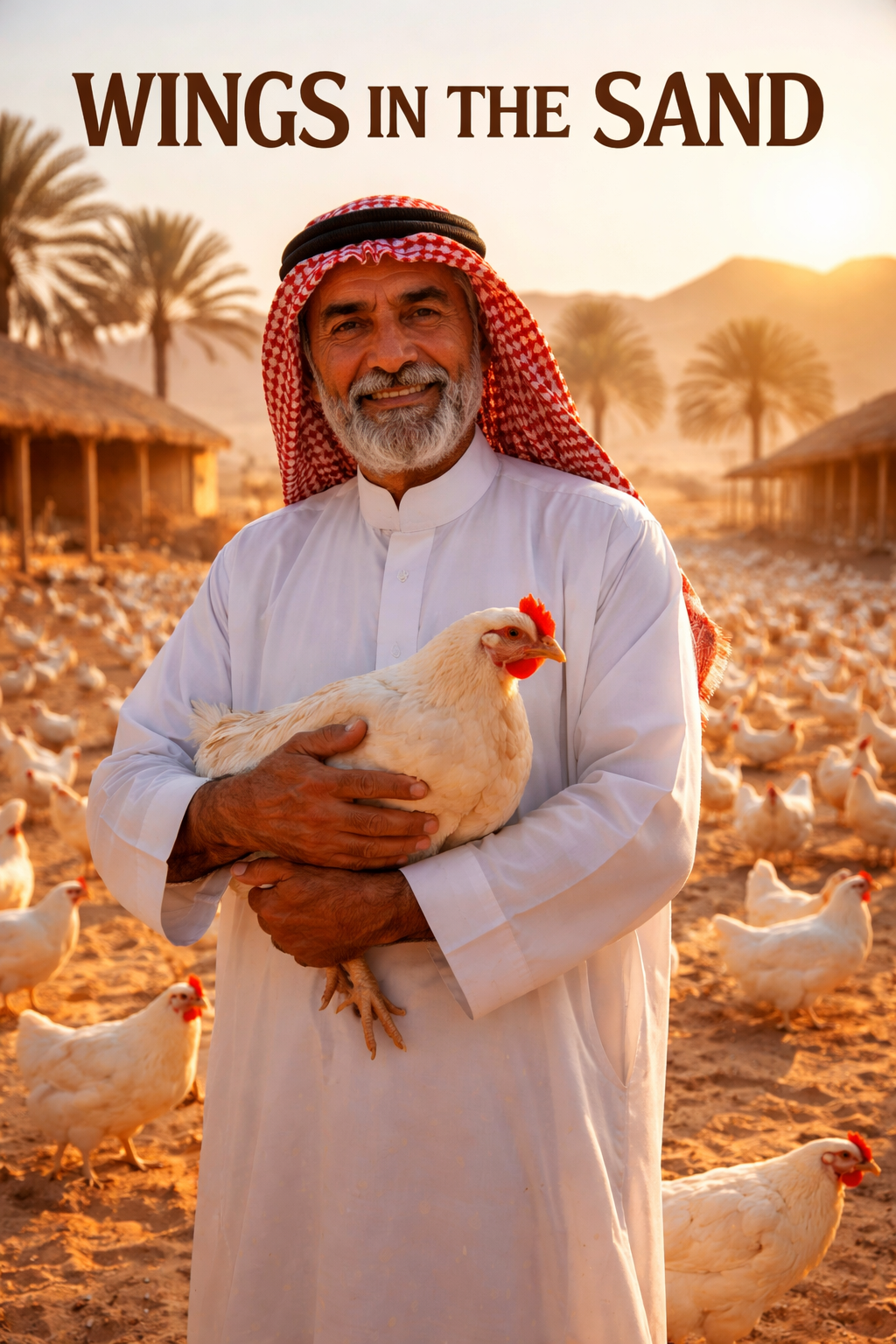
When people asked Arvin what he did in Saudi Arabia, he used to hesitate before answering.
“I take care of chickens,” he would say, half-smiling, as if the job needed an apology.
Back home in Nueva Ecija, he had once worked as a tricycle driver. His days were filled with honking horns, dusty roads, and bargaining passengers. But when his wife became pregnant with their third child and rice prices dropped, driving wasn’t enough anymore.
So he signed a contract to work as a poultry farm worker what the agency called a “chicken farm attendant” in Al-Qassim, a region known for agriculture in the middle of the Saudi desert.
He had never been on a plane before.
The first time he saw the farm, he blinked in disbelief. It stretched across the dry land like a small city made of long metal buildings. Inside those buildings were thousands upon thousands of white chickens, their soft clucking blending into a constant wave of sound.
The desert outside was silent and vast. Inside the poultry houses, life pulsed loudly.
Arvin’s job was simple in description but heavy in responsibility: monitor feeding systems, check water lines, remove sick birds, clean sections, and make sure temperature controls were working. A single mistake too much heat, too little ventilation could cost thousands of lives.
“Always check twice,” his supervisor, a stern Egyptian man named Hassan, told him on the first day. “Chickens are sensitive. They cannot complain. You must notice.”
The smell inside the poultry houses was strong feed, feathers, and ammonia. At first, Arvin struggled to breath through it. He tied a cloth tighter around his nose and pushed forward.
“You’ll get used to it,” said Rahim, a fellow worker from Bangladesh.
And he did.
Every morning before sunrise, Arvin walked across the dusty ground to Building 7, where he was assigned. The desert sky would glow faint orange as he unlocked the door and stepped into the warm, humming interior.
Thousands of small eyes blinked under artificial lights. The feeding machines rattled softly, dropping measured portions of grain.
He moved carefully through narrow pathways. Boots crunching against bedding material. He learned to spot subtle signs of illness a drooping head, a bird not moving with the rest. He gently picked up weak chickens and transferred them to a separate enclosure.
At first, he felt strange talking to them.
“Eat well,” he would murmur absentmindedly while adjusting feed lines.
Back home, he had raised a few native chickens in their backyard. But nothing like this scale. Here, the birds were part of a system timed, monitored, recorded.
Still, they were living creatures.
In the evenings, after twelve-hour shifts, Arvin returned to the shared quarters near the farm. The building was basic bunk beds, a small kitchen, one television that picked up Arabic channels.
He would shower carefully, scrubbing away the farm smell, then sit on his bed and call home.
His wife, Lorna, would answer with their children crowding around the phone.
“Papa!” His eldest would shout. “Show us the chickens!”
He would laugh and switch the camera briefly to the distant poultry houses glowing under floodlights.
“So many!” His middle child would gasp.
“Yes,” Arvin would say. “Thousands. I take care of them.”
“What are their names?” His youngest once asked innocently.
Arvin paused, then grinned. “All of them are named “Opportunity.”
Lorna rolled her eyes affectionately. “Just come home safe.”
Life on the farm was repetitive but demanding. Temperatures had to stay within strict limits. During summer, the desert heat outside could rise above 45 degrees Celsius. Cooling systems worked nonstop. If they failed, even briefly, disaster could happen.
One afternoon, an alarm shrieked through Building 7.
Arvin’s heart pounded. He checked the control panel ventilation malfunction.
Without hesitation, he radioed Hassan and rushed to inspect the fans. The air inside felt heavier already.
“Manual override!” Hassan shouted when he arrived.
Together, they worked quickly, adjusting backups systems and opening emergency vents. Sweat poured down Arvin’s face/ The noise of distressed chickens grew louder.
After what felt like hours but was likely only minutes the airflow stabilized. The birds slowly settled.
Hassan wiped his forehead and looked at Arvin. “Good reaction,” he said firmly. “You saved many.”
That night, lying in his bunk, Arvin stared at the ceiling. He wasn’t a doctor or engineer. But he had protected lives that day, even if they had wings and feathers.
The months passed.
He learned basic Arabic phrases. He memorized feed schedules. He sent money home consistently. Lorna paid off debts, enrolled their eldest in a better school, and even started saving a little.
But homesickness came in waves.
He missed the sound of rain hitting their tin roof. He missed the laughter of neighbors. He missed holding his youngest child, who seemed to grow taller with every video call.
During one particularly lonely evening, Arvin walked outside after dinner. The desert sky was clear, filled with more stars than he had ever seen. There were no city lights nearby to compare with them.
He sat on the sandy ground and whispered a quiet prayer.
“Lord, give me strength.”
The desert wind brushed against his face gently, almost like an answer.
One day, Hassan approached him with unexpected news.
“The company is expanding,” he said. “We need a team leader for new building. I recommend you.”
Arvin blinked in surprise. “Me?”
“You are careful. Responsible. Not lazy,” Hassan replied bluntly.
The promotion meant a slight salary increase. More responsibility. Longer hours.
He called Lorna immediately.
“Leader na Ako,” he said shyly.
“Of course,” she replied proudly. “You’ve always been.”
As a team leader, Arvin trained new workers teaching them how to observe, how to move calmly among the birds, how to react quickly when systems failed.
“Listen to the sound,” he would say. “If it changes, something is wrong.”
He realized he had grown not just in skill, but in confidence.
Two years after arriving in Saudi Arabia, Arvin stood at the edge of the farm during sunset. The long poultry houses cast shadows across the sand. Truck waited to transport grown chickens to markets.
He watched them go, thinking about cycles. Life raised, life sent forward.
Like him.
He had come to the desert unsure and embarrassed to say he was a chicken farmer. Now he understood the dignity of it.
He wasn’t just feeding birds.
He was feeding his family’s future.
When his contract ended, he returned to Nueva Ecija with savings enough to start a small poultry business of his own. Not thousands of birds but enough.
On the first morning in his backyard farm, he scattered feed across the ground. Chickens clucked and hurried toward him.
His children laughed nearby.
Lorna handed him a cup of coffee. “From Saudi to here,” she said softly.
Arvin smiled at the rising sun over the fields.
“Yes,” he replied. “From desert sand to our own land.”
He no longer hesitated when people asked what he did.
“I’m a chicken, farmer,” he would say proudly.
Because he had learned something important under the wide Saudi sky.
Even the smallest wings can carry big dreams.