
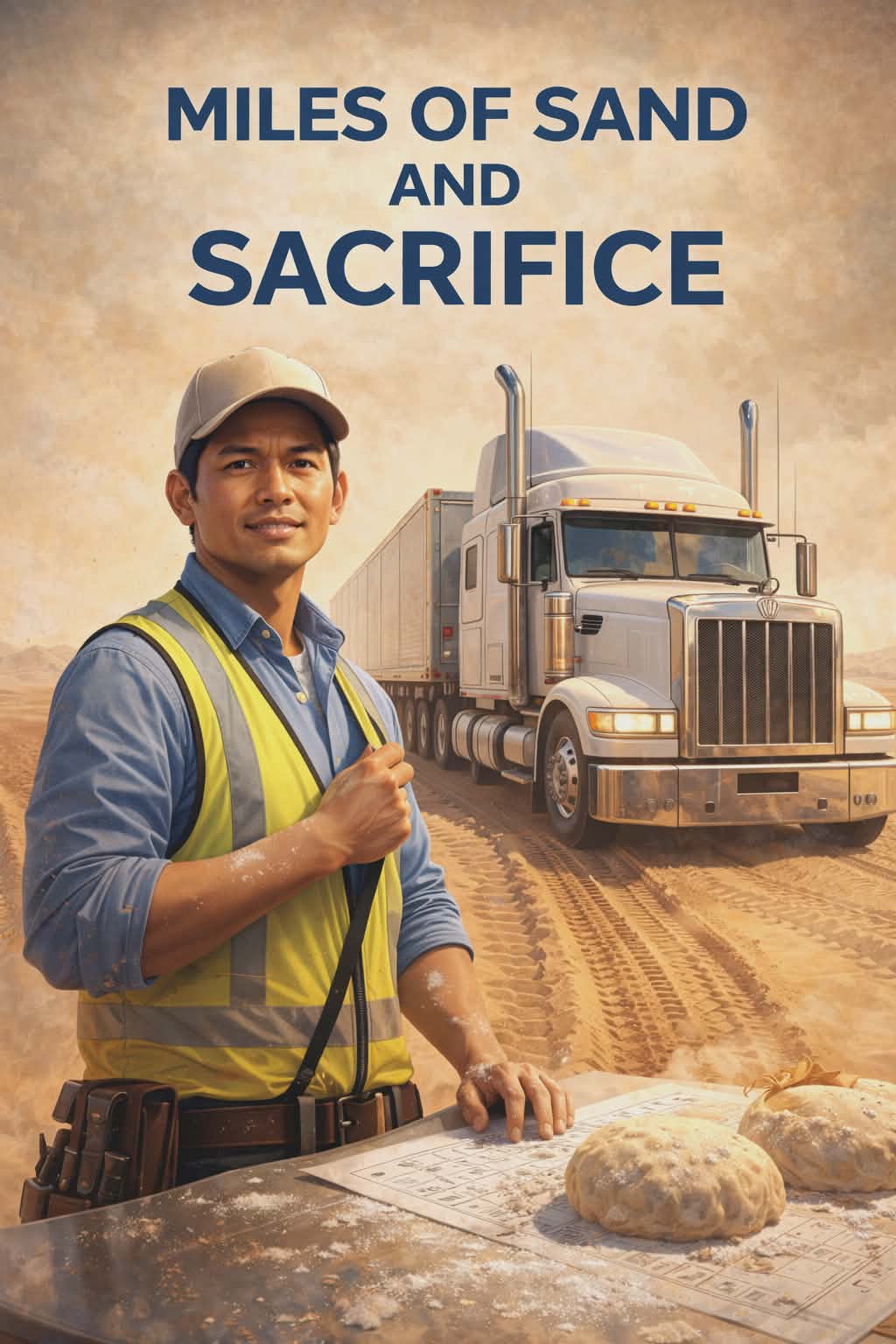
Rogelio never imagined that the road he would travel most in life would not lead to a destination but would be the destination itself.
Back in Nueva Ecija, he used to drive a battered jeepney along dustry provincial routes. He knew every pothole, every waiting passenger, every roadside vendor selling boiled corn. The earnings were modest, sometimes uncertain, but the roads were familiar.
Familiarity, however, did not pay hospital bills.
When his youngest child was diagnosed with a heart condition requiring regular checkups, Rogelio and his wife made a decision that felt heavier than any steering wheel he had ever held. He applied for a job as a heavy truck driver in Saudi Arabia.
Two months later, he stood beneath the blazing sun of Riyadh, staring at a massive eighteen-wheeler that would become both his livelihood and his companion.
The desert was unlike anything he had seen. Endless stretches of sand met a horizon that shimmered in heat. Highways cut through the emptiness like dark ribbons. There were no tricycle horns. No roadside sari-sari stores. Only wind and distance.
His job was straightforward but demanding transport construction materials between cities, sometimes driving for ten to twelve hours across long desert highways. Cement, steel beams, machinery his cargo changed, but the responsibility remained the same.
One mistake could mean disaster.
The first time he drove alone across the desert, silence wrapped around him. The engine hummed steadily. Sand dunes rolled endlessly on either side. He tightened his grip on the wheel, reminding himself why he was there.
For his children.
Every kilometer carried purpose.
He quickly learned the rhythm of desert driving. Leave before sunrise to avoid the harshest heat. Monitor tire pressure carefully sand and temperature fluctuations could be unforgiving. Stop at designated rest points to check cargo straps and drink water.
The heat was relentless. Even inside the truck’s air-conditioned cabin, sunlight felt aggressive. During loading and unloading, sweat soaked through his uniform within minutes.
But payday made the exhaustion worthwhile.
Each month, he sent most of his salary back home. His wife managed hospital appointments and medications. Slowly, debts decreased. Savings grew.
Through video calls, he watched his children grow. His eldest daughter proudly showed him her report cards. His son talked excitedly about basketball practice. His youngest, the one with the heart condition, would wave shyly at the camera.
“Drive safe, Papa,” the little one would whisper.
Those words echoed in Rogelio’s mind every time he started the engine.
Life in the driver’s accommodation was simple. Shared rooms. Metal bunk beds. Conversations in mixed languages Tagalog, Arabic, Hindi, Urdu. Fellow drivers shared stories of highways, checkpoints, and families waiting thousands of miles away.
They bonded over late-night cups of tea and laughter that masked homesickness.
There were dangerous days.
Once, during a sandstorm, visibility dropped almost to zero. The sky turned orange-gray. Sand battered the windshield like endless rain. Rogelio slowed down carefully, hazard lights blinking, heart pounding.
He thought of his children’s faces.
He thought of promises.
He pulled over safely at the nearest rest stop, waiting out the storm. As the wind howled outside, he whispered a quiet prayer of gratitude for survival.
Driving in a foreign land required more than skill it required patience, alertness, and resilience. He learned basic Arabic phrases to communicate at checkpoints. He memorized routes connecting Riyadh to Dammam, Jeddah to smaller industrial towns.
Highways became his routine. Gas stations his brief social hubs. The truck cabin his moving home.
Sometimes, loneliness crept in during long night drives. The desert at night felt vast and infinite. Stars shone brighter than he had ever seen in the Philippines. He would roll down the window slightly, letting cool air brush his face, and think about the narrow streets of Nueva Ecija.
He missed birthdays parties. School graduations. Simple Sunday lunches.
But one evening, his wife sent him a photo that made him pull over.
His youngest child stood outside a clinic, smiling widely, holding a medical report. The doctor had said the condition was improving significantly.
Rogelio stared at the image for a long time.
Every mile suddenly felt lighter.
Years passed beneath the desert sun.
With careful saving, Rogelio began planning for the future. He dreamed of buying his own delivery truck back home starting a small logistics business so he would not have to leave again.
He studied routes in Saudi Arabia not just as a driver, but as someone learning about transport efficiency. He observed how companies managed fleets, scheduled deliveries, and maintained vehicles. He asked questions when mechanics serviced his truck.
He was preparing, even if no one else knew it.
On his final of contract, he felt a mix of pride and exhaustion. His hair had more gray. His hands were rougher. But his savings were enough to make the next step possible.
When he finally boarded his flight back to the Philippines, he carried more than luggage. He carried years of sunrise departures, sandstorms survived, and highways conquered.
At the airport arrival gate, his family waited eagerly.
His youngest child ran toward him first.
“Papa! You’re home!”
Rogelio knelt down, hugging tightly, breathing in the familiar scent of home humidity, perfume, and something indescribably comforting.
Months later, a small white delivery truck with his name painted on the side rolled through the streets of Nueva Ecija. It wasn’t as massive as the eighteen-wheeler he drove in Saudi Arabia, but it was his.
Neighbors waved as he passed.
This time, when he drove long hours, the destination was always home.
The desert had tested his endurance. It had stretched roads endlessly before him and demanded courage during storms. But it had also given him something priceless the chance to secure his child’s health and build a stable future.
As he parked the truck outside his modest house one evening, watching his children play in the yard, he realized something powerful:
He had driven thousands of miles across foreign highways.
But the most important journey he ever made was the one brought him back.