When Jack left in Manila, the sky was the color of tin dull and heavy, like it might collapse at any moment. His mother cried quietly at the airport, pressing a rosary into his palm as if were a boarding pass to something safer then Europe. His father, who had spent thirty years repairing jeepney engines, simply nodded and said, “Build something that lasts.
Jack carried those words with him to the Netherlands.
He had been hired as a civil engineer for a water management firm based in Rotterdam. Back home, he had worked on flood control projects in Pampanga, measuring river depths under a punishing sun. In the Netherlands, he would be working below sea level, in a country that had mastered the art of holding back water for centuries.
The first thing he noticed when he arrived was the wind. It moved differently colder, more deliberate, as if it had a schedule to keep. It rushed over flat fields stitched with canals and wind turbines that turned like patient giants.
His apartment was small but immaculate, with a window overlooking a narrow canal. Ducks floated past in the mornings, unbothered by the cyclists gliding along brick pats. Jack watched them on his first Sunday there, sipping instant coffee he’d brought from home. Everything felt orderly, efficient so unlike the chaos he’d grown up in.
At work, he was assigned to a team designing reinforcement for an aging dike system in a coastal town north of Amsterdam. Rising sea levels had made the project urgent. The Dutch engineers spoke English fluently, though they slipped into Dutch during meetings when the discussion became animated. Jack listened carefully, scribbling notes, determined not to be the quiet foreigner in the corner.
His supervisor, Marieke, was direct but fair. On his second week. She asked him to present his analysis of soil stability along a vulnerable stretch of coastline.
“Do not be shy,” she told him. “We value good ideas, not loud voices.
That night, Jack rehearsed in his apartment, his laptop balanced on the narrow dining table. He practiced explaining how a hybrid solution combining reinforced concrete with a vegetated foreland could absorb wave energy more effectively. It was a method inspired by mangrove restoration projects he’d studied in the Philippines.
When he presented by the next day, his voice trembled at first. But as he described how mangroves reduced storm surges back home, something shifted. He was no longer just an overseas worker trying to prove himself; he was an engineer carrying knowledge across oceans.
The room grew quiet not dismissive, but attentive.
Marieke learned forward. “You are suggesting we work with nature instead of against it.”
“Yes,” Ramon said, feeling steadier. “The sea will always push back. But maybe we can soften the push.
The proposal was not adopted immediately. There were budget constraints, regulatory frameworks, risk assessments. But the team agreed to conduct simulations. Ramon walked home that evening under a pale pink sky, feeling lighter than he hade in months.
Still, life outside work was harder.
He missed the noise of Manila the tricycle horns, the karaoke drifting from open windows, his younger sister’s laughter as she crammed for nursing exams. In the Netherlands, evenings were quiet. Too quiet. The supermarket’s closed early. The neighbors nodded politely but kept their distance.
On his birthday, he video-called his family. They had gathered around a small table with a store-bought cake, singing off-key. The internet lag made their voices overlap in strange echoes.
“Kuya, when are you coming home?” His sister asked.
“Soon,” he lied, smiling.
The truth was, he didn’t know. His contract was for three years, and most of his salary went back home to tuition fees, to medical bills for his father’s hypertension, to a modest house renovation they had to postponed for years.
One rainy afternoon, as Jack inspected a construction site near the coast, he met an elderly Dutch man standing by the temporary fencing. The man wore a wool cap and leaned on a bicycle.
“You are building higher walls?” The man asked in accented English.
“Yes,” Jack replied. “Stronger ones.”
The man gazed toward the gray sea. “When I was a boy, my father told me that water is patient. It waits. We must be more patient.”
Jack thought about that long after the man cycled away. In the Philippines, floods came like thieves in the night sudden, destructive. Here, the battle with water was calculated, almost philosophical.
Months passed. Winter arrived, bringing frost that etched delicate patterns on his window. Jack bought his first thick coat and learned to bike to work, wobbling at first but eventually gliding with cautious confidence.
The simulations for his hybrid design showed promise. Vegetated foreshores reduced wave impact by nearly fifteen percent in certain conditions. It wasn’t revolutionary, but it was significant.
During a meeting with municipal officials, Marieke surprised him.
“I would like Jack to explain this section,” she said, gesturing to the slides.
He stood before the officials men and women in tailored coats and serious expressions and spoke about resilience. About how engineering could borrow wisdom from ecosystems. He did not mention mangroves this time, but he carried their image in his mind: tangled roots gripping muddy shores back home. Afterward, one official approached him. ‘Your idea,” she said, “it is… Humane. Not just technical.
Jack smiled. “Thank you.”
By spring, the project incorporated a pilot section using his proposed approach. It was modest, a test stretch along a less populated area. But when construction began, Jack felt something inside him settle a quiet affirmation that he belonged there.
He began to see parallels between his own life and the structures he designed. Like the dikes, he had left familiar ground to stand against unfamiliar tides. Like the vegetated foreshores, he was trying to root himself in foreign soil without losing where he came from.
On a rare sunny weekend, he took a train to a small coastal village. He walked along the reinforced shoreline, watching children fly kites against the wind. The sea shimmered, deceptively calm.
He called his father.
‘They are building your project?” His father asked.
“A small part of it,” Jack said. “It’s a start.”
His father was silent for a moment. Then he said, “You remember what I told you?”
“Build something that lasts,” Jack replied.
“Yes. Not only walls. Also your name.”
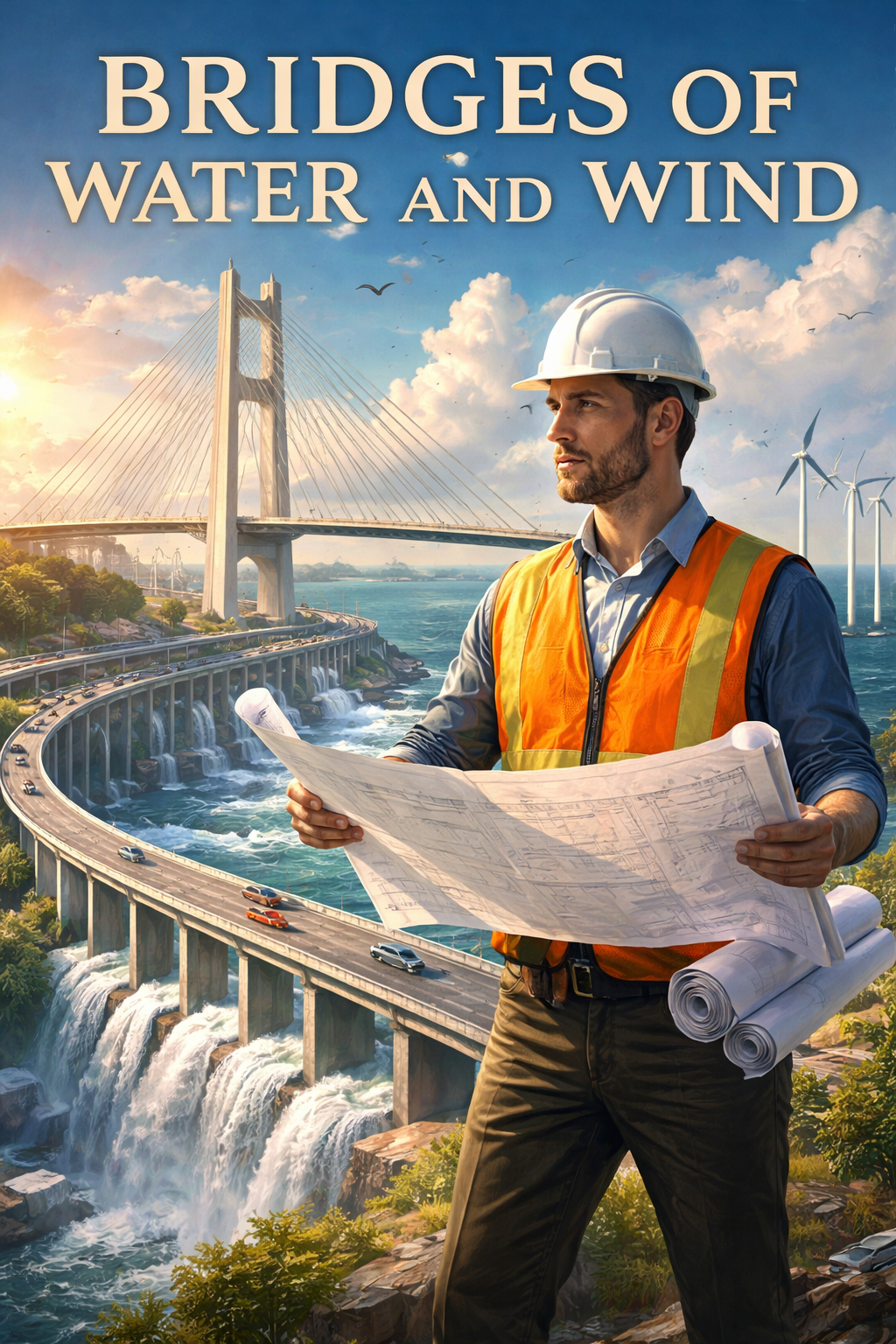
Jack looked out at the horizon where water met sky in a thin silver line. He realized that what he was building was more than infrastructure. It was a bridge between tropical storms and North Sea tempests, between a son’s obligation and his own ambition, between the Philippines and the Netherlands.
He was still an OFW, still sending money home, still counting the years until he might return for good. But he was also an engineer shaping a coastline in a land that had welcomed hime with wind and challenge.
As the sun dipped lower, painting the water gold, Jack felt the steady presence of both countries within him. The Netherlands had taught him precision and patience. The Philippines had taught him resilience and heart.
And somewhere between water and wind, he was learning to stand firm, flexible, and enduring.