
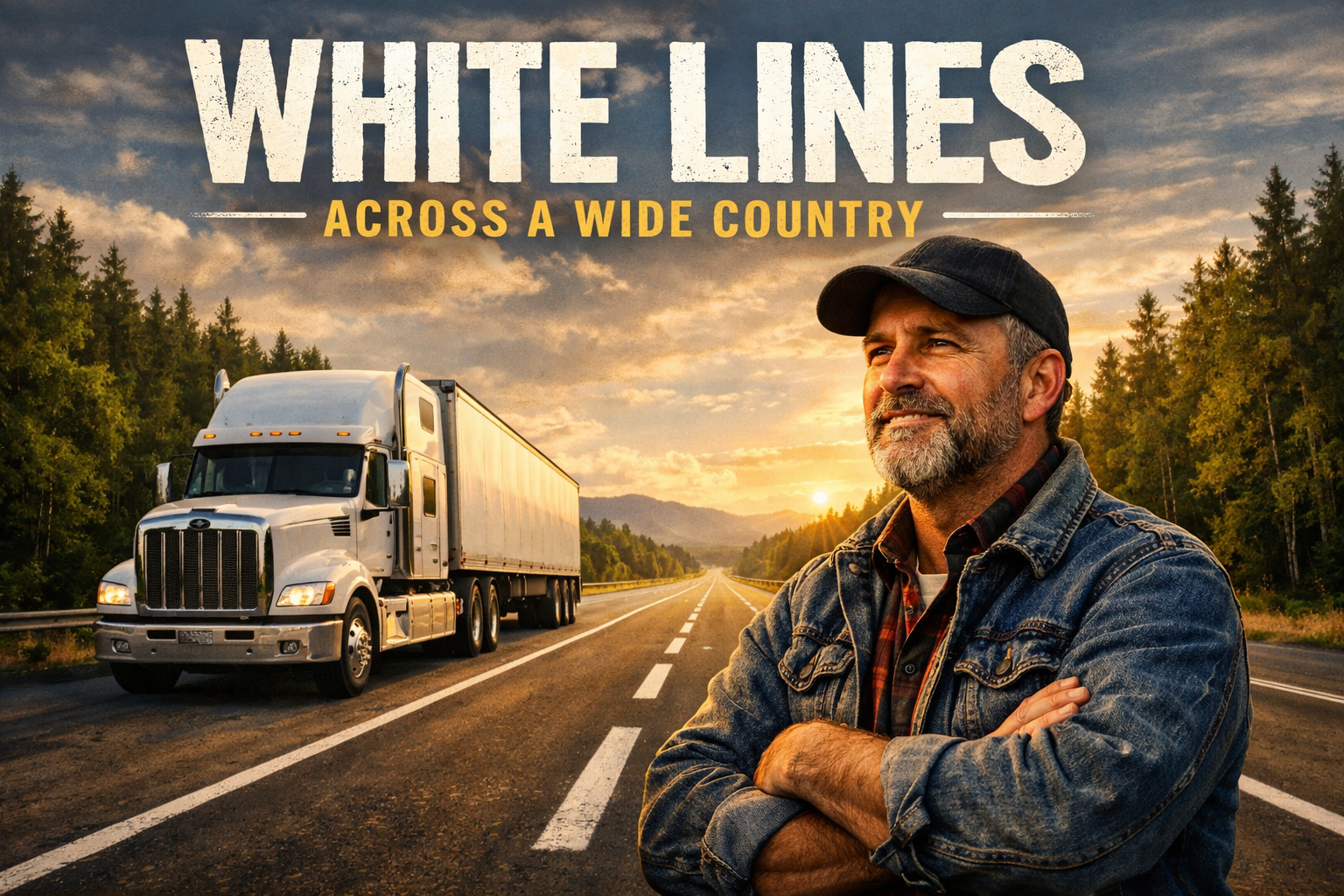
On the morning Eli Navarro decided not to quit, the sky over Winnipeg was the color of unpolished steel. Snow drifted sideways across the yard of Prairie Star Logistics, blurring the rows of idling rigs into hulking shadows. Eli stood with a paper cup of coffee warming his palms and watched his breath unravel into the cold.
He had been driving long-haul across Canada for nine years. Long enough to measure his life in kilometers. Long enough to know the way the road hummed differently in each province. Long enough to feel the ache of missing birthdays and barbecues and the small, unremarkable evenings that made up a family’s spine.
His daughter Sofia had turned twelve the week before. He’d sung to her through a phone propped on the dashboard while parked outside a rest stop in northern Ontario. She’d smiled bravely, but the candlelight had flickered in her eyes like something fragile.
Eli took a final swallow of coffee and climbed into his cab. The heater coughed to life. His route would carry him west along the Trans-Canada Highway, across the flat white sweep of the Prairies, over the muscular spine of the Rockies, and into the wet green breath of the coast. Frozen chicken outbound. Auto parts back.
He eased the truck onto the highway as dawn smeared pale pink across the horizon.
Driving across Canada is an exercise in patience. The Prairies do not reveal their secrets quickly. For hours, sometimes days, the land lies open and spare, fields stitched with fence lines, grain silos rising like lonely sentinels. In winter, the wind sculpts snow into drifts that resemble ocean waves caught mid-crest.
Eli liked the solitude most days. The radio murmured talk shows and country ballads. He tracked weather reports, scanned for black ice, kept his speed steady. The truck became an extension of his body every vibration a language he understood.
By afternoon, the wind sharpened. Snow thickened, swallowing the edges of the road. The world narrowed to white lines and the red glow of taillights ahead.
His phone buzzed through the Bluetooth system.
“Papa!” Sofia’s voice crackled through static. “Mom says there’s a storm warning where you are.”
“There’s always a storm somewhere.” He said lightly. “I’m driving slow. I promise.”
“Don’t be a hero.”
He smiled. “Never.”
After the call ended, he tightened his grip on the wheel.
Near the Saskatchewan border, traffic slowed to a crawl. A jackknifed trailer blocked one lane, hazard lights blinking like frantic eyes. Snowplows worked methodically, pushing back drifts that seemed determined to reclaim the asphalt.
Eli parked and stepped out to check his load. The cold hit like a slap. Other drivers emerged from their cabs, boots crunching in unison. There’s an unspoken fraternity among truckers on winter roads a recognition that survival is often communal.
A woman in a blue parks approached, her reflective vest flashing in the storm. “You heading west?” she asked.
“Vancouver,” he replied.
She nodded toward the stranded trailer. “Driver’s shaken up. Could use an extra pair of hands once the tow arrives.”
Eli didn’t hesitate.
They worked together in the wind, securing flapping tarps and clearing snow from beneath the wheels. The stranded driver, a young man with wide eyes, kept apologizing.
“It happens,” Eli told him. “The road teaches all of us.”
By the time the highway reopened, night had fallen. Eli’s shoulders ached, but something inside him felt steadier.
He pressed on, crossing into Alberta under a sky strewn with brittle stars. At a truck stop outside Medicine Hat, he fueled up and slid into a booth near the window. The diner smelled of frying onions and strong coffee.
Across from him sat an older driver with a beard the color of frost. They nodded in mutual acknowledgement.
“Road’s rough,” the man said.
“Worse east of here,” Eli replied.
They ate in companionable silence, two travelers bound by asphalt. On the way out, the older driver clapped Eli’s shoulder. “See you down the line.”
Down the line.
The phrase lingered as Eli climbed back into his cab. The road was a line, yes but it was also a thread stitching together cities, forests, mountains, and people who might otherwise remain strangers.
Two days later, the Rockies rose ahead, jagged and unapologetic. Snow clung to their flanks, and clouds pooled in their valleys like spilled milk. Eli shifted gears, engine straining as the incline steepened.
Mountain driving demanded respect. Curves tightened without warning. Ice hid in shadowed corners. He kept his speed controlled, eyes scanning constantly.
Halfway up a pass, traffic halted again. This time it was a chain-up checkpoint. Eli pulled over, tugged on insulated gloves, and hauled heavy chains from a side compartment. He knelt in the snow, threading metal links around massive tires, fingers numbing despite thick fabric.
As he worked, he remembered Sofia learning to tie her shoelaces tongue peeking out in concentration. “Loop, swoop, and pull,” she’d chanted.
He finished securing the chains and stood, breathing hard. The mountains loomed above him, ancient and indifferent.
The descent on the other side was slow and deliberate. When at last the road leveled and the air softened, Eli felt as though he’d crossed not just a range but a threshold.
British Columbia welcomed him with rain instead of snow. Evergreen trees crowded the highway, their branches heavy and fragrant. The sky lowered to a gentle gray.
In a distribution yard outside Vancouver, he backed into a loading dock with practiced precision. The trailer doors swung open, releasing a breath of cold air and the faint scent of frozen cargo.
While workers unloaded pallets, Eli stepped away and called home.
“I mase it,” he said when Sofia answered.
“I knew you would.”
He could hear dishes clinking in the background, the small domestic sounds that felt both distant and immediate.
“Dad?” She said hesitantly. “When I’m older, can I ride with you one day? Across the whole country?”
He imagined her in the passenger seat, sneakers propped in the dashboard, eyes wide as the landscape shifted from flat to fierce to forested.
“I’d like that,” he said. “I’d like that very much.”
After the call, Eli stood for a moment beneath the drizzle. He thought about quitting the missed holidays, the long stretches of solitude, the relentless weather.
But he also thought about the stranded driver in the storm, the nod in the diner, the chain-up in the mountains. He thought about how each kilometer carried not just freight but connection.
The road was hard. It demanded patience, vigilance, sacrifice.
Yet it also offered a kind of quiet purpose.
When the trailer was empty and paperwork signed, Eli climbed back into his cab. Soon he would turn east again, tracing the same vast line in reverse.
He adjusted his mirrors, checked his gauges, and eased onto the highway. The tires hummed against wet pavement, steady and sure.
Somewhere far ahead, beyond forests and fields and cities stitched together by white lines, a girl waited for stories about snowstorms and mountains. And Eli Navarro, truck driver of Canada’s endless roads, drove on not because the journey was easy, but because it mattered.