
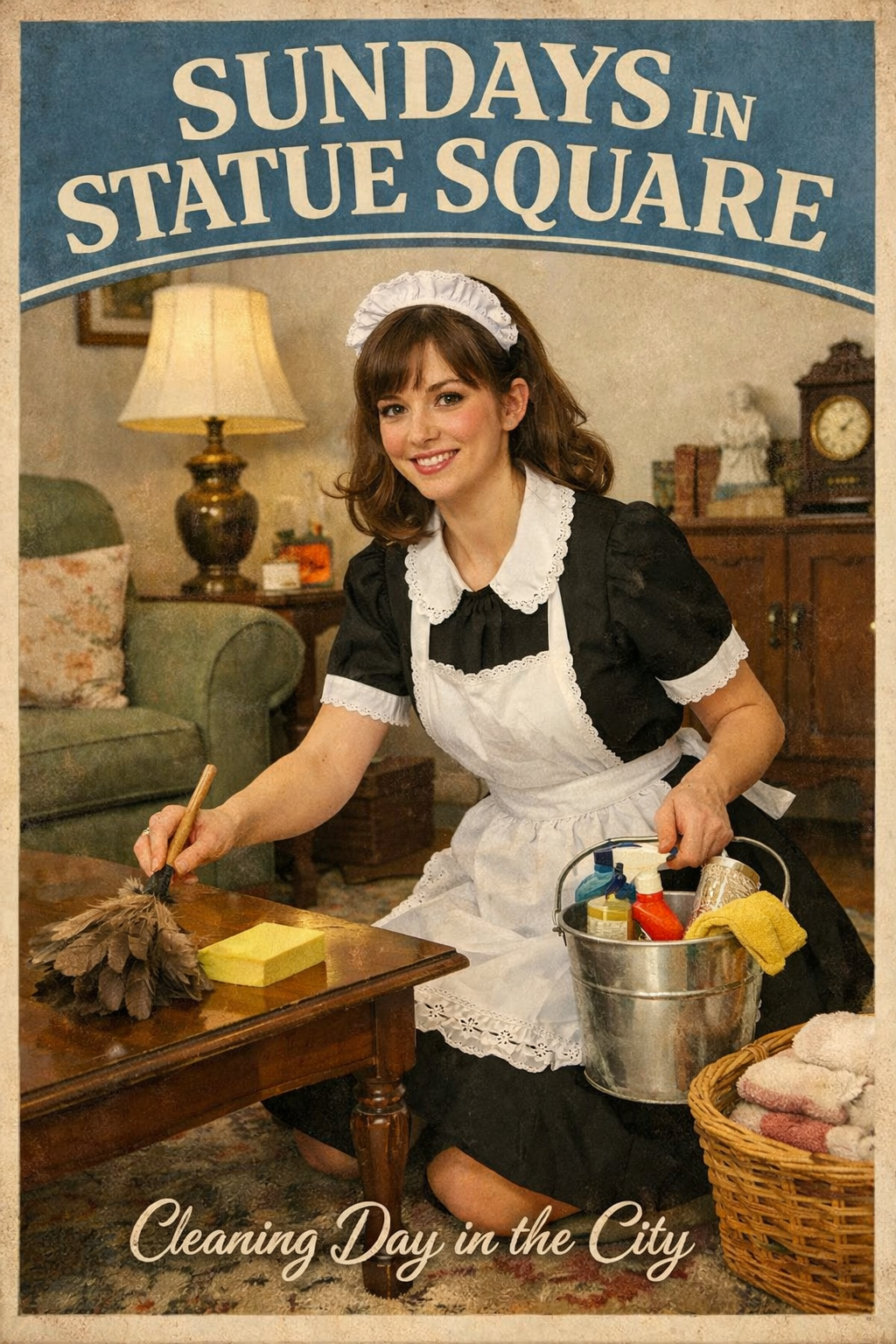
On her first Sunday in Hong Kong, Lila followed the river of women flowing out of the MTR station and into the bright maze of Central. They carried cardboard like treasure flattened appliance boxes tucked under arms, folded and refolded until the creases turned white. Lila carried her own piece, rescued from the alley behind the bakery near her employer’s building. It still smelled faintly of sugar and heat.
By noon, the footbridges were carpeted with cardboard islands. Women sat cross-legged in neat circles, sharing rice wrapped in banana leaves, passing phones from hand to hand so babies could wave from distant kitchens and living rooms. The city above them glittered in glass and steel, but down here there were slippers kicked off, hair loosened from tight buns, and laughter rising like bright birds.
Lila found her cousin Mercy near the steps of Statue Square. Mercy had been in Hong Kong for six years and had perfected the art of claiming space without apology.
“You’re thin,” Mercy said, pulling Lila into a hug. “But your eyes are still brave.”
Lila smiled. “They’re learning.”
She had arrived three months ago, hired by a family in Mid-levels: a couple with two children and a golden retriever that shed like a second season. The apartment was smaller than the house she had grown up in black in Iloilo, but it rose twenty floors above the street, and the windows did not open fully. Everything had a rule: how long the air-conditioning could run, how the shirts must be ironed, which sponge was for plates and which for counters.
On weekdays, Lila woke before six. She boiled water, packed lunchboxes, coaxed eight year old Oliver into his uniform and negotiated with five year old Chloe about her socks. She walked the dog along steep roads where banyan roots cracked the pavement. She learned to move quietly, to anticipate the rhythm of the household the way Mrs. Chan’s heels clicked differently when she was late for a meeting, the way Mr. Chan cleared his throat before asking for tea.
But on Sundays, Lila stepped into the open air and reclaimed her name.
Mercy introduced her to the others: Ana. Who sent half her salary home to pay for her brother’s engineering degree; Putri, who could braid hair so tight it held through typhoon winds; Sari, who carried a small notebook of Cantonese phrases she practiced with stubborn devotion.
They spread their cardboard and built a temporary living room. Someone produced a Bluetooth speaker. Someone else handed Lila a plastic container of adobo, still warm.
“Do they treat you well?” Mercy asked softly, when the music swelled and the others were distracted.
Lila considered the question carefully. Mrs. Chan was exacting but fair. Mr. Chan sometimes forgot to say thank you. The children had begun to leave her drawings on her pillow crayon suns and stick figures holding hands.
“They treat me… Like part of the furniture,” Lila said at last. “Useful> Necessary. But not always seen.”
Mercy nodded. “Then make sure you see yourself.”
In the weeks that followed, Lila carried those words like a talisman.
She began to notice the small territories where she could leave her mark. She rearranged the spice drawer so Mrs. Chan could find star anise without rummaging. She taught Chloe how to invented new chapters when the book ran out of pages.
At night, after dishes were stacked and the dog finally stilled, Lila lay on her narrow bed in the utility room. She scrolled through photos of her own son, Mateo, who lived with her mother back home. He had lost his first tooth without her. He had learned to rise a bicycle without her steadying the seat.
The guilt came like humidity thick, inescapable.
One Thursday, Mrs. Chan called Lila into the living room.
“My mother will be staying with us for a few months,” she said. “She is particular about her tea. And her congee. And everything.”
The grandmother arrived with two suitcases and a gaze sharp as a sewing needle. She spoke rapid Cantonese that Lila struggled to follow, her words slicing through the apartment like swift birds. On the first morning, she rejected the congee as too thin. On the second, she rearranged the kitchen shelves Lila had so carefully ordered.
Lila felt herself shrinking, becoming smaller than the utility room she slept in.
That Sunday, under the overpass near Statue Square, she confessed her frustration.
“I try so hard,” she said. “But it’s never enough.”
Sari closed her notebook. “Then stop trying to be enough for everyone,” she said gently. “Be enough for yourself first.
The advice seemed impossible, almost selfish. Yet on Monday, when the grandmother criticized the way Lila sliced ginger, Lila inhaled slowly and asked, in careful Cantonese, “Can you show me how you prefer it?
The older woman paused, surprised.
She demonstrated thin coins, nearly transparent. Lila imitated her. The grandmother nodded once, curt but approving.
It was a small victory, but it shifted something. Instead of bracing for disapproval, Lila began to treat the grandmother as a teacher. She asked about the soups she remembered from her own childhood, about festivals and family traditions. In return, she shared stories of Iloilo of mango trees heavy with fruit, of jeepneys painted like moving rainbows.
One afternoon, Chloe came home from school in tears. A classmate had mocked her for bringing rice instead of sandwiches.
“They said it smells,” Chloe sobbed.
Lila knelt beside her. “Smells like what?”
“Like home,” Chloe whispered miserably.
Lila smiled. “Then they are jealous. Because home is the best smell there is.”
The grandmother, listening from the sofa, made a soft sound of agreement.
That evening, she asked Lila to teach Chloe how to cook a simple fried rice. Together they stood at the stove three generations, three accents weaving through the steam. Oliver wandered in, drawn by the scent, and asked for a bowl.
The kitchen felt less like a workplace and more like a shared hearth.
On her sixth month in Hong Kong, Lila received a video call from her mother. Mateo grinned at the screen, holding up a certificate from school. “Top of my class, Mama!” he shouted.
Pride and ache collided in her chest.
“I’m saving,” she told him. “For your books. For your dreams.
That Sunday, the women in Statue Square celebrated her son’s achievement with store-bought cupcakes and off-key singing. The cardboard beneath them softened from so many weeks of use, edges fraying but still sturdy.
As the sun dipped behind the skyscrapers, casting long shadows across central, Lila looked around at the circles of women thousands of temporary living rooms stitched together by sacrifice and resilience. Above them, the city pulsed with commerce and speed. Down here, time slowed, thick with stories.
She realized that being a domestic helper in Hong Kong meant existing in two worlds at once: the private sphere of someone else’s family and the vast, open sisterhood of women who understood the cost of leaving.
Neither world was entirely hers.
Yet both shaped her.
When the evening breeze lifted the corners of their cardboard mats, Lila pressed hers flat and stood. Tomorrow she would wake before dawn again. She would boil water, iron uniforms, and walk the dog along the steep roads.
But she would also carry within her the memory of laughter echoing beneath flyovers, the taste of adobo shared among friends, the knowledge that she tasks she completed.
She was a bridge between countries, between generations, between the woman she had been and the one she was becoming.
And every Sunday, in the heart of Hong Kong, she rebuilt her island from cardboard and courage, reminding herself that even temporary spaces can hold permanent strength.